Tuesday, February 26, 2008
Differential Leveling
The purpose of this lab is to use differential leveling to find the difference in elevation from Sci-Tech up to the library. The students are using transit levels and elevation rods. Part of the exercise is making the notes come out right.


Tuesday, February 19, 2008
Irony or Serendipity On Carbon Credits?
I was looking for the dates (Nov. 5-8) for the Soc. of American Foresters Convention in Reno next fall, and discovered that the keynote speaker will be Michael J. Walsh, the executive director of the Chicago Climate Exchange (CCX). CCX is the official marketplace for trading carbon credits under a cap and trade arrangement to reduce carbon emissions by industry. It is currently voluntary, but may become mandatory some day under new government regulations. We just heard a discussion on carbon trading at the Allegheny SAF meeting in Carlisle last week. Carbon trading raises many questions. Is it just a way for polluters to pay for continuing pollution or is it a serious effort to reduce pollution? Will the costs of running the market and the profits for the traders outway any benefits to society? I am certainly looking forward to hearing this speaker and attending the Convention!
Allegheny SAF Meeting Followup
Last week's Allegheny SAF meeting in Carlisle into some critical issues in forest management in our region. The Forest Management Practices assignment was to research the topic before the meeting and write a followup report based on the speakers' presentations. Here are the student reports (in their blogs) on these issues:
- Pennsylvania's Approach to Bioenergy/Ecosystem Services (Carbon Sequestration): Trent Ausherman, Kyle Peck, and John Westerfer.
- Carbon Credits and Trading Schemes: Andrew Baker, Josh Reiter, and Chance Yeckley.
- Cellulosic Ethanol from Forests. What is it? Will it work? Logan Droppa, Matt Reitzel.
- Utilization of Low ValueWood for Biofuel in Schools and Other Institutions: Dave Gillen, Tiffany Roddy.
- Natural Resources / Forestry Education. Trends and Issues: Darren Krebs, Ryan Thrush.
Monday, February 18, 2008
Bio-Control of Invasive Species


Dr. Don Davis, a forest pathologist from Penn State described the discovery of two species of Verticillium fungus that seem able to control the spread of Ailanthus altissima (tree of heaven). Dr. Davis noticed that stands of Ailanthus in the Tuscarora State Forest were diminishing and even dying.
With his graduate students he isolated two species of soil fungi that seemed to be doing the quick. V. albo-atrum kills trees quickly and V. dahlia doesn't kill the trees outright but causes symptoms of morbidity and reduced growth. A lot of work remains to be done to determine if these fungi can be used on a wider scale to control the rapidly-spreading tree of heaven. Here is Dr. Davis' web site.
Mile-a-minute is a rapidly spreading weed in the mid-Atlantic. Originally from China, the variety in the US is thought to have come from China. Here is a link to more information on mile-a-minute.
Dr. Judith Hough-Goldstein from the University of Delaware described research to introduce a weevil from China that can slow down or suppress mile-a-minute. The stem-boring weevil, Rhinoncomimus latipes Korotyaev, attacks the plant from the inside. It won't kill mile-a-minute, but will reduce it to manageable levels. Here is the web page that describes the work and how to get weevils to try out on your own infestations.
Friday, February 15, 2008
Allegheny Society of American Foresters Meeting
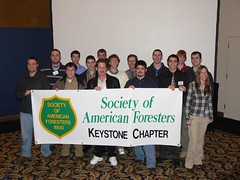
P1020940
Originally uploaded by P_Linehan.
Fifteen forest technology students from Penn State Mont Alto attended the Winter meeting of the Allegheny SAF in Carlisle on Thursday.
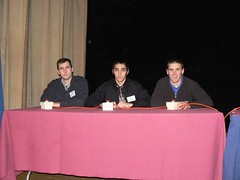
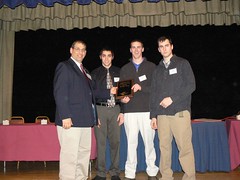
The quiz bowl team of Frank Grano, Chance Yeckley, and Eric Monger won the Quiz Bowl after an exciting match agains Penn State University Park.
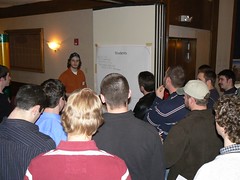
John Schwartzer (Mont Alto alum and UP forestry senior) leads a student discussion on issues in forestry education.
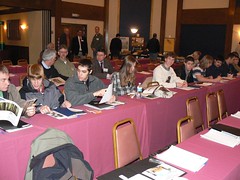
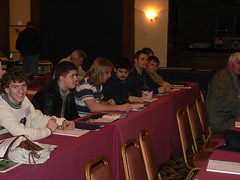
Among the issues discussed at the meeting were bio-energy from forests in PA, carbon markets, wood pellet systems for heating school buildings, forestry education in the Allegheny region, and advances in biological controls of invasive plants. The students in the forest management practices class will be writing reports on the meeting for their blogs. I will add links in this space next week.
Friday, February 08, 2008
Burn Pile Service Project
P1020885
Originally uploaded by P_Linehan.
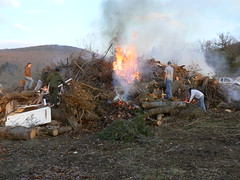
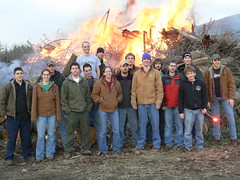
Penn State Mont Alto forestry students are lighting the burn pile on the nursery field. Volunteers will work shifts all weekend to guard the fire. Much of this material came from the ice storm last December that cut power to campus over a whole weekend. Bring on the hot dogs!
Saturday, January 19, 2008
Increase of Timber Theft

This article, in today's New York Times, highlights an increasing problem of timber theft around the country. It highlights a landowner in Vermont who lost thirty or so of his best sugar maple trees, that were logged by his neighbor. The landowner was awarded $30,000 in a subsequent civil suit.
The article point out that many of the victims are elderly or poor and seldom get redress. Some species, such as black walnut, are so valuable that they have always been susceptible to timber theft. Experts aren't sure if the amount of theft is greater today, since many cases are never reported. With the high demand for American hardwood species around the world, land owners need to stay vigilant to protect their forests.
Thursday, December 27, 2007
GPS satellite developments

GPS World discusses Russia's recent launch of three more GLONASS satellites. This brings the total available satellites to 18, enough for navigation in Russia. Russia hopes to have a complete constellation of GPS satellites working by 2009. There was a recent news story of President Putin with his dog showing how a GLONASS-based GPS tracking device was now possible.
This follows last week's successful launch of a new GPS satellite, also described in GPS World. The new GPS IIR-18 (M) satellite will replace an existing older unit. It provides a stronger civilian signal and some new capabilities for military navigation.
This news is exciting for anyone interested in GPS. Within a few years we will have the choice of receivers using NAVSTAR (American), Galileo (European), or GLONASS (Russian). There will certainly be combinations of the different systems for even better accuracy and reliability. The combinations may be subscription-based for the extra service. I am sure there will be intense competition among providers to provide good deals and packages.
Maybe they will even solve the problem of good reception under a closed forest canopy with a low cost receiver!
Friday, November 30, 2007
Mass Tree Planting in Indonesia
 I heard recently on NPR and the BBC News about a massive tree planting campaign in Indonesia. Governmenta agencies all over the country were planning to plant over 79 million trees! Indonesia is usually known for its deforestation of tropical forests and the overwhelming smog from forest fires.
From the reports I heard, I feel optimistic that this campaign may be successful. First, it is a locally initiated campaign. The people seem to be behind it, rather than having it imposed from outside. They have chosen some interesting species. In addition to teak and other timber species they will be planting fruit trees that people want.
As I saw in Africa, tree planting campaigns will only work if they have popular support. Otherwise it's just too hard to make the tree-planting a success. This doesn't resolve the problem of forest clearing and fires, but it does point in the right direction.
Wednesday, November 28, 2007
Anne Frank Chestnut Tree

One of the first blog entries I made last year was on the chestnut tree outside the Anne Frank house in Amsterdam. This was the tree she mentioned frequently in her diary during her family's two year hiding from the Nazis.
The city of Amsterdam wants to remove the tree because of its advanced state of decay. Now, a year later, people who want to save the tree have sued to prevent it being cut. After hearing arguments on both sides a judge ordered the city to hold off until February. Here is a link to a BBC story on the tree.
It's interesting that the managers of the Anne Frank Museum at the house want the tree removed to prevent injury to visitors. They would rather replant a new, healthy tree. Sounds like a good idea to me.
Thursday, November 01, 2007
Where am I?
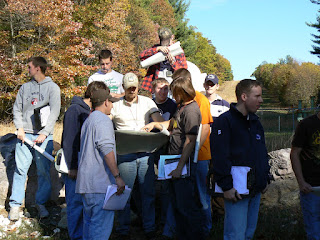
Reading topographic maps is a critical skill for all foresters. We can use contour lines to see a landscape in three dimensions. Here students from the Forest Mapping class are matching their location to the features on a topographic map in the Michaux State Forest and the Waynesboro Watershed.


Tuesday, October 30, 2007
SAF National Convention
There was a lot of good information that was given at the convention. The thing that I enjoyed the most was the job exibits. I enjoy talking to people about new things, and learning new things. I met one women that is a spokes person for this new product called bird water that you can put in the ground, and it will water your trees for 90 days. While testing the product, hte resultz are outstanding. also talking with other school about their programs and getting new ideas and sharing ideas to bring back to our own schools. The one schools Forestry Club does a cost scaring program for their forestry books. You rent the book for the semester and then you get your money back at the end when you return the book. The job fair wasn't that interesting to me because the majority of the jobs were for working out west in Oregon or sorrounding area. I met a man named Al who graduated from Mont Alto in 1937 he had a lot of great stories to share with us, and he will be sending me some pictures and videos that I will share with you. For anyone that is interested in SAF I would jump on hte opertunity to go to a national meeting, it is very educational, and a wonderful experience to be in a new place.
Sunday, October 28, 2007
Rethinking Fire Policy in the Tinderbox Zone
This article in today's New York Times stresses changes in building codes in California to protect new homes in the most dangerous fire zones. (It also has some good photos and maps.) The changes came about because of the damage from previous fires. Even the best built homes can't withstand a total fire. The authors stress that Californians continue to rebuild in the proven danger zones, as well as build new homes. I wonder how they are able to afford home owner's insurance
Friday, October 26, 2007
Convention at Oregon
First thing is first, the plane rides were a great experience for my first times flying. The convention center had interesting artwork, one was a large sculpture of a Ginkgo fruit. The bag that they gave out to everyone was nicer than the one they gave at Pittsburg. The thing(s) that I enjoyed the most was the job fair and the people that I met and heard. My favorite speaker was Richard Louv, who spoke about his concern about children not being able or just not bounding with nature. He is also the author of "Last Child in the Woods". One of the interesting people that I met was Erkki, who is from Finland. One of the things that he brought up was a question "How many lakes in Finland?". The answer that he gave me was 184,000+ lakes and the smallest lake is one acre in size. He said that 10% of Finland is water and the area where he lives is 25% water. Another interesting thing that Erkki said was that any last name ending with nen, meant that they are a Fin.
Thursday, October 25, 2007
Richard Louv SAF Keynote Speaker

Richard Louv, author of Last Child in the Woods was the keynote speaker at the SAF Convention today. Before his prepared remarks he mentioned the fires in California. His home is in San Diego in the danger zone. So far his home is safe and hopefully will stay that way.
For a number of reasons children are losing this contact with the outdoors. Electronic toys, parents' fears, and a too-structured lifestyle are just some of the reasons. He says that the increase in childhood obesity, increased ADD, and the increase of stressed children are just some of the consequences. In part he blamed his own profession, journalism, for creating a climate of fear by magnifying all the dangers out there, that results in many families keeping their children under house arrest.
He cited a number of initiatives and programs to get children back outdoors. Although he says it's unlikely we will ever go back to the days of letting children roam free, we have to make sure children have that connection to the outdoors that all people need.
He really connected to this audience of foresters. Just about all of us had our special outdoor place growing up. Most of us still have one today. He did inspire all of us to try harder to find ways to work with children. That will be good for them and good for the profession of forestry.
Here is a link to Louv's web page and a link to his books in Google search.
Louv did a book signing later in the day. There was a huge line, over a hundred people I guess, waiting. The SAF shop even sold out of the book.
New Tools at SAF Convention
The SAF convention is a great way to find new developments and new tools for foresters. The Portland convention is no exception. The USGS is demonstrating a new viewer for Landsat data. It has archival data and some of the most recent data from the current satellite. At the booth they showed how the imagery from various bands can be combined. I can't wait to have more time to look at it at home. http://glovis.usgs.gov
Another new tool is a brand new website interface for the FIA national forest inventory data. Previously, we had to wait for the inventory reports to come out in book form. Now the Forest Service has created a modern interface to zero in on the forestry statistics even down to the local data. fiatools.fs.fed.us The people demonstrating the site told me it just came on line last week. The help files aren't even up yet. It will be fun to learn.
Another new tool is a brand new website interface for the FIA national forest inventory data. Previously, we had to wait for the inventory reports to come out in book form. Now the Forest Service has created a modern interface to zero in on the forestry statistics even down to the local data. fiatools.fs.fed.us The people demonstrating the site told me it just came on line last week. The help files aren't even up yet. It will be fun to learn.
Sunday, October 21, 2007
Mega-Fires on 60 Minutes

60 Minutes ran thought-provoking story on the increased number of extremely severe "mega-fires" in the West. Here is a link to the story on the CBS News page. The site has an article, video, and still pictures. (I'm not sure how long it will be up.)
Reporter Scott Pelley went to Idaho to visit a hot-shot crew on a fire line near Ketcham. He did an in-depth interview with Tom Boatner, who is the chief of fire operations for the federal government. Boatner confirmed that fires are larger and more frequent. He also mentioned changes in fire-fighting rules to let more areas burn if property is not threatened. They conducted the interview near the a burning fire and had to move downhill as the temperature increased!
Pelley also interviewed Tom Swetnam, a fire ecologist from the University of Arizona. Swetnam has studied the dendrochronological record and found that fire severity is much larger. They have a tremendous collection of aged cross-sections of old logs that recorded firest over the last few millenia. I am eager to look up some of his research articles.
Both Boatner and Swetnam cite climate changes towards drier conditions and a longer burning season. Global warming was mentioned several times as the cause.
Global warming may well be an underlying of the problem. But the direct causes are well known: a rapid increase in population, people building more in the wilderness area, and changes in forest management policy. The good news is that these problems can be fixed quickly if people want to. All in all, this was a very interesting report. I hope people pay attention.
Friday, October 19, 2007
Ipe wood
Ipe wood is one of the coolest woods ever!! It is almost denser than water 0.9. It doesn't require chemical applications to prevent termite or mold damage. It even has the fire resistance of concrete or steel, though it will burn up eventually. Ipe wood is great for decking.
Sunday, October 07, 2007
Old Railroad Ties
P1020244
Originally uploaded by P_Linehan.
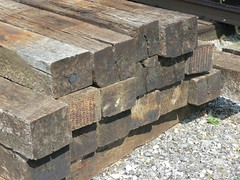
This stack of old railroad ties I found next to an exhibit of a restored railroad caboose in Norlo Park in Guilford township, Pa. The ties reminded me of how important creosote preservation was for the railroad and almost all other outdoor uses of wood.
Of course creosote, a type of oil, is very toxic. It also leaked from the wood creating even more hazards. The sites of creosote factories are Superfund waste sites. For example, the old creosote plant in Pensacola, FL was a massive cleanup headache. Fortunately, we have other ways to preserve wood. Railroad ties are often made from other materials. we should never forget about the imoprtance of creosote, though.
Wednesday, October 03, 2007
One of the last Fire Lookouts
Today's New York Times has a feature article on Michael Gates who is a contract fire watcher on Saddleback Mountain in the Tahoe National Forest in California. Gates lives for five months of the year in a lookout shack atop the nearly 7,000 foot mountain. The article has some amazing pictures of life in the shack and views around the mountain.
Gates also has his own photo gallery with some amazing shots, many from the watchtower.
There are fewer and fewer manned lookouts (only 800 left) around as the US Forest Service and State Forest Services go to modern technologies. It takes a special person to endure living there. But I'm sure there are advantages to having a pair of human eyes watching the skyline for fires.
Many forest technology students want to work fighting fires. Not so many would want to work in a fire tower I think.
Gates also has his own photo gallery with some amazing shots, many from the watchtower.
There are fewer and fewer manned lookouts (only 800 left) around as the US Forest Service and State Forest Services go to modern technologies. It takes a special person to endure living there. But I'm sure there are advantages to having a pair of human eyes watching the skyline for fires.
Many forest technology students want to work fighting fires. Not so many would want to work in a fire tower I think.
Subscribe to:
Posts (Atom)