With this week's big winter storm (at least big by mid-atlantic standards) I didn't make it to the first day of the Society of American Foresters Allegheny meeting in Hagerstown, MD. But there were some very interesting talks on Thursday morning (2-15) that made the trip worthwhile.
David Curson, the director of bird conservation for the MD/DE Audubon Society of talked about the Important Bird Areas Program (IBA). This is an attempt to identify critical habitat for endangered bird species. The program has been successful by working with the federally mandated State Wildlife Action Plans (SWAP). This voluntary program actually favors active forest management, since there are many species of birds requiring the whole range of habitats from clearcuts to older growth forests.
Dan Heddrick, of the Maryland DNR Forest Service, described a research project in western MD to study timber harvesting on small plots (1 to 10 acres). The logger is using a four-wheeler and a chain saw. The study will examine the economic feasibility and social acceptability of the work.
With land fragmentation becoming a critical problem, landowners of small lots (ten acres or less) need help with what to do on their properties. Jonathan Kays of the the Maryland Cooperative Extension Service described a new manual/workbook for these landowners, titled The Woods in Your Backyard. The workbook has been audience tested and should help landowners who are tired of moving their lawns and want to bring a little nature back. http://www.naturalresources.umd.edu/backyard.cfm
Al Todd of the Forest Service gave a summary of the recent report The State of Chesapeake Forests from the Conservation Fund. The report was presented to the governors of the states draining into the Chesapeake who are all members of the Chesapeake Bay Program. Forest fragmentation and development are causing deforestation, soil erosion, and loss of habitat that are having a dire effect on the bay. We risk losing all the environmental services that the forests and the bay provides. According to the report, we are close to the point of no return, where decisive action needs to be taken.
The director of the Maryland Forest Service, Steve Koehn, gave the final word. According to Steve, the problems of development, ownership fragmentation, and deforestation, are affecting all natual resources uses and industries. Foresters need to become politically active to influence the situation. We have to show how these problems affect people's lives, health, and pocketbooks to get the decision makers (politicians) to take action.
Only the Penn State University Park students made it to the meeting. So instead of a quiz bowl, they had an old-timers vs. students quiz bowl. Next year Mont Alto and the other schools will all be there for a real competition.
Friday, February 16, 2007


Monday, February 05, 2007
Flatbush Gardener: Be an NYC Tree Guardian
Flatbush Gardener: Be an NYC Tree Guardian
Here's an interesting entry from the Flatbush Gardener about ways citizens can protect street trees in New York City. Most people don't realize that New York City has a very extensive forested park system. It also has thousands of street trees. These trees grow in a very stressful environment. Without the active support of the people of New York, they wouldn't survive at all.
That's an important lesson for forester. Trees and forests won't prosper, let alone survive, in today's world unless people think they should. Foresters need to work as much with people as with the forests.
Here's an interesting entry from the Flatbush Gardener about ways citizens can protect street trees in New York City. Most people don't realize that New York City has a very extensive forested park system. It also has thousands of street trees. These trees grow in a very stressful environment. Without the active support of the people of New York, they wouldn't survive at all.
That's an important lesson for forester. Trees and forests won't prosper, let alone survive, in today's world unless people think they should. Foresters need to work as much with people as with the forests.
Friday, January 26, 2007
Forest Damage in Europe

As we were discussing in forest management this week, forests, both natural and plantations, are very stable, safe investments. The probability of damage from fire, insects, or weather is actually quite low when you consider forests as a whole.
But when damage occurs it can be catastrophic. Here is a quote on the recent storm damage in Sweden:
"About 12 million cubic metres have been estimated to be damaged in the recent storm that swept southern Sweden 14 January. Next to the storm “Gudrun” two years ago this is the most severe storm since 1969. Much of the storm-felled trees are within areas that already have a high risk of large-scale outbreak of the European Spruce bark beetle."
Here is the link to the article: http://www.nordicforestry.org/article.asp?Data_ID_Article=2263&Data_ID_Channel=33
The damage in Germany is equally serious: "
Forestry officials said the hurricane that tore through Germany killing 11 people last week also knocked down 40 million trees. The damage was expected to cost the industry dearly." http://www.dw-world.de/dw/article/0,2144,2323760,00.html
So, forests are usually safe, but when something bad happens it can be very bad.Thanks to Eggers Thies (Sweden information) and David South (Germany information) for these leads
Monday, January 22, 2007
Queen of Trees


Tonight (1/21) the PBS Nature series broadcast a documentary on the life cycle of the African fig tree (http://www.pbs.org/wnet/nature/queenoftrees/)
The film was made highlighting a tree in Kenya. Here are some pictures I took recently of a fig tree in Guinea, across the continent, at the C.E.E.D. in Kinkan. These pictures seem to be of a very similar, if not exactly the same, species as the one on the show. It's an amazingly complicated life-cycle, with a very precise relationship between the fig tree and the wasp. The fruit here are immature. I noticed ants on them, but didn't see any wasps.
Sunday, January 21, 2007
Forest Contrasts


These are pictures of forests from opposite sides of the world. The single tree is a nere tree (Parkia biglobosa) in the Fouta Djalon highlands of Guinea (near the Kinkan Waterfalls). The forest is a white pine plantation (Pinus strobus) on the Waynesboro Watershed in Hamiltonban Township in Pennsylvania USA. I visited these two landscapes withing ten days of each other in January 07. Jet travel is great!
In spite of the obvious contrasts in continent and climate these two scenes have similarities. Both have trees and both are heavily influenced by human use. The same principles of forest management and soil conservation can be used to manage both landscapes for the benefit of people and the environment.
Saturday, December 09, 2006
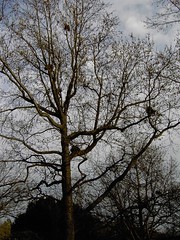
Squirrel Nests
Tuesday, November 28, 2006
Forester Web Sites
In the Forestry Computer Applications course students learn many computer techniques that are needed in forestry such as spreadsheets and document preparation. Communication in the digital requires knowledge of the web. Here are the sites that this fall's students are developing. Remember, they are works in progress.
Student | Web Site |
Andrew Baker | |
Logan Droppa | |
Jason Freeman | |
David Gillen | |
Darren Krebs | |
Josh Reiter | |
Matt Reitzel | |
Tiffany Roddy | |
Ryan Thrush | |
John Westerfer | |
Chance Yeckley |
Sunday, November 26, 2006
Pennsylvania Deer Season

Tomorrow is the start of Pennsylvania's two week statewide deer hunting season. As this article in the Harrisburg Patriot News shows there is still a great deal of mistrust among hunters of the increased doe limits and the concurrent doe and buck season. (See the PA Game Commission site, where I linked to this picture.)
Many of the hunters are saying that deer are becoming scarcer and harder to find. The article points out that with more bucks surviving each year, they are becoming more wily and better able to evade hunters. In any case, it's still true that in much of Pennsylvania it is impossible to regenerate a hardwood forest without a big investment in deer fencing. See my previous post. It doesn't make sense to allow one use of the forest (deer hunting) to monopolize all the other uses and even deter efforts to regenerate forests for future use.
I truly hope this year's hunt goes off in safety with no hunter accidents.
Wednesday, November 22, 2006
The Shifting North Pole

The December 2006 National Geographic has an amazing map of the 700 mile movement of the North Magnetic Pole since its discovery in 1831. If it keeps on moving like it has in the past, it will be in Russia in a few years. The accompanying notes by Joel K. Bourne, Jr. indicates the pole is moving at a rate of 25 miles a year! The article suggests that "... it might be be time to trade that trusty compass for a handheld GPS."
Actually, compasses are very reliable on a day to day basis while GPS receivers are subject to periodic outages and loss of signal under certain conditions. I recommend carrying both into the field. A magnetic compass needs no batteries, while a GPS offers a large number of navigation and tracking tools.
I looked on the National Geographic web site to see if the map in the magazine is online. As of today it isn't. But they do have this news article from last December describing research by Joe Stoner, a paleomagnetist at Oregon State University. He has found that the movement of the pole is completely normal. It gives researchers a window into the liquid iron core at the center of the earth. It also influences the aurora borealis!
Monday, November 20, 2006
Forest Fires and Global Warming
Mont Alto alumnus Eric Straley sent me this news link http://news.yahoo.com/s/ap/20061116/ap_on_sc/cooling_fires about a study of the long term effects of forest fires in northern (spruce fir) forests. It seems that the fire releases large quantities of carbon and pollutants at first. But the next year the same site with longer lasting snow cover and light-colored hardwood regrowth will actually reflect light back to space which would reduce global warming. It takes at least 80 years for the dark-colored softwood forest to be re-established.
The article quotes the researchers as saying that wildfires are just one factor in global warming and this issue needs more study to understand what's going on. However, as global warming is a long term phenomenon made up of the sum of all activities on earth I get a little skeptical about the importance of individual studies of one part of a very complicated system. It's not enough to really decided how to change policies and actions.
Thanks, Eric, for the interesting article and stay warm in Anchorage, AL!
The article quotes the researchers as saying that wildfires are just one factor in global warming and this issue needs more study to understand what's going on. However, as global warming is a long term phenomenon made up of the sum of all activities on earth I get a little skeptical about the importance of individual studies of one part of a very complicated system. It's not enough to really decided how to change policies and actions.
Thanks, Eric, for the interesting article and stay warm in Anchorage, AL!
Wednesday, November 15, 2006
Ann Frank Chestnut Tree to be Cut Down

Officials in Amsterdam have concluded that the Anne Frank chestnut tree is too badly infected to be saved and should be cut down. According to news accounts the 150-170 year old tree has been attacked has been attacked by an aggressive fungus and a moth, called the horse chestnut leaf miner.
In her diary, written while her family was hiding from the Nazis in an apartment in a nearby warehouse the teenage Anne wrote movingly how the tree inspired her and gave her hope.
Here is a link to a website with information on the tree and the people it has inspired. Officials at the Anne Frank museum are planning to plant a new chestnut sapling after the old tree has been removed in the next few weeks.
Sunday, November 12, 2006
Google vs. Yahoo! Imagery
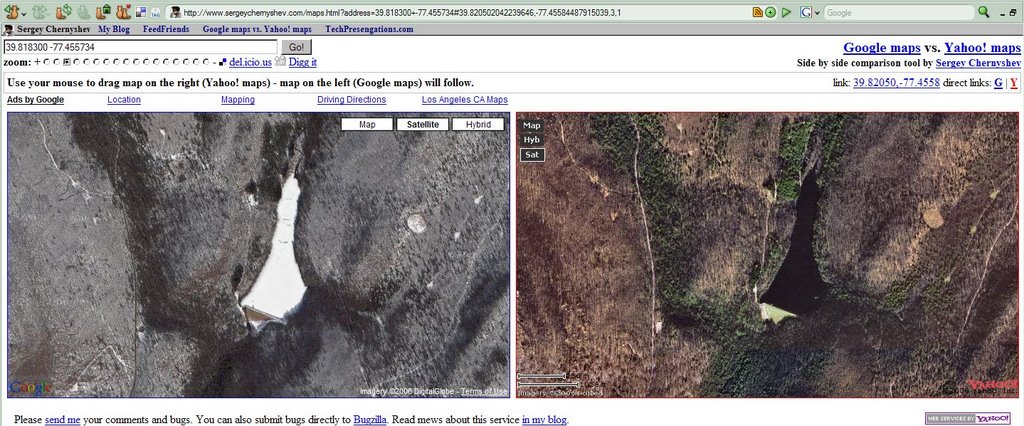
The image above is a screen capture from an amazing map hack by Sergey Chernyshev that puts Google (left) and Yahoo! maps side by side. To get the above comparison of the Waynesboro Reservoir in the Waynesboro Watershed (where we hold many labs in the Penn State Mont Alto forest technology program) first go to this web address: http://www.sergeychernyshev.com/maps.html . Then enter these search coordinates: 39.818300 -77.455734 (latitude and longitude). Make sure to choose satellite imagery to see just the images or hybrid to see the images and roads.
Both images are high resolution, high quality. Online mapping services tend to have spotty coverage of the best imagery around the US. Google shows a winter scene, where the reservoir is frozen. Yahoo! shows a slightly color enhanced summer scene. The road networks use the same data from Navteq. It' great to be able to see them together side by side.
Online mapping is a trend. It's likely that foresters and other natural resource managers will be using these tools in the future to improve their understanding of the forests and to make field work more efficient. Thanks, Sergey, for this new tool.
Wednesday, November 08, 2006
Plant a Billion Trees
http://www.foxnews.com/story/0,2933,228198,00.html
Wangari Maathai, who was just the keynote speaker at the Soc. of American Foresters Convention in Pittsburgh, is calling for a billion trees to be planted to slow global warming. I admire her reliance on citizen groups and women power rather than government programs. They have a greater chance to succeed in the long run. What a change that would make!
Wangari Maathai, who was just the keynote speaker at the Soc. of American Foresters Convention in Pittsburgh, is calling for a billion trees to be planted to slow global warming. I admire her reliance on citizen groups and women power rather than government programs. They have a greater chance to succeed in the long run. What a change that would make!
Tuesday, November 07, 2006
We are here.

Learning GPS
PICT0134
Originally uploaded by P_Linehan.
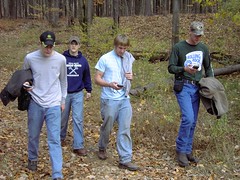
GPS receivers have become ubiquitous tools for forestry field work to locate forest inventory plots, mark trails, and a host of other tasks. Here students in the Forest Mapping Systems class at Penn State Mont Alto are returning from recording waypoints on a trail in the Michaux State Forest.
Monday, November 06, 2006
Deer Fencing
PICT0128
Originally uploaded by P_Linehan.
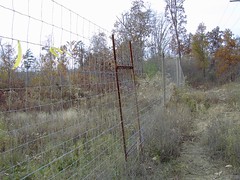
To regenerate a forest in Pennsylvania deer fencing is a must. Here in the Michaux State Forest next to Penn State Mont Alto campus a deer fence has been set up to allow oak regeneration after a thinning in a pine stand. The gate is to let people in, but keep deer out.
Sunday, November 05, 2006

More forestry tools
More of Jim Nelson's tools. At the center is a chain (66 feet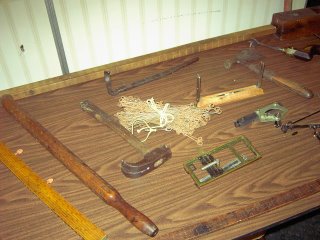 ) made up of 100 links. The rulers are log rules.
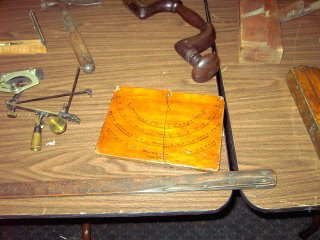 In this photo is a student-made clinometer, possibly from Mont Alto. An old washer provides the plumb weight. The instrument has several scales, such as percent, degrees, and tree height at one chain.
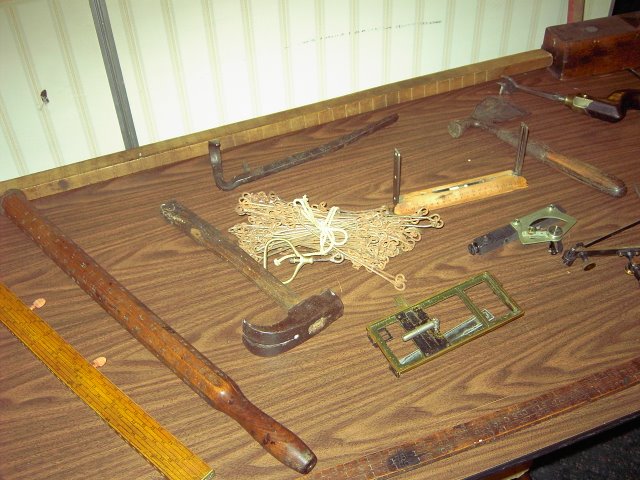 ) made up of 100 links. The rulers are log rules.
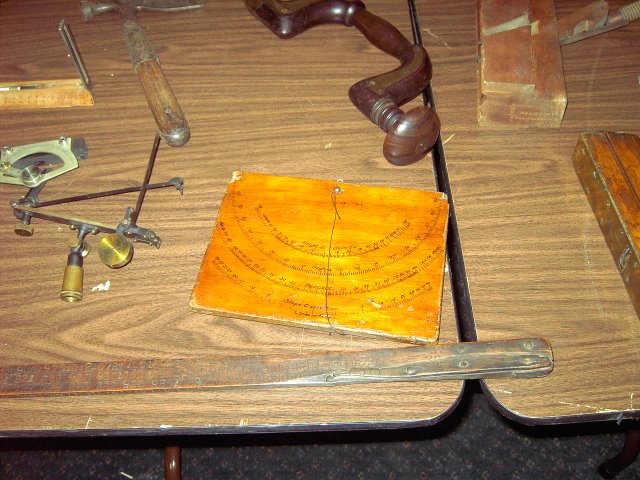 In this photo is a student-made clinometer, possibly from Mont Alto. An old washer provides the plumb weight. The instrument has several scales, such as percent, degrees, and tree height at one chain.
Pennsylvania Forest Fire Museum Annual Meeting

Yesterday was the annual meeting of the PFFMA in Chambersburg. Here is the group shot. There were some interesting developments for the museum project. A temporary museum will soon be opening in the old office building at Caledonia State Park.
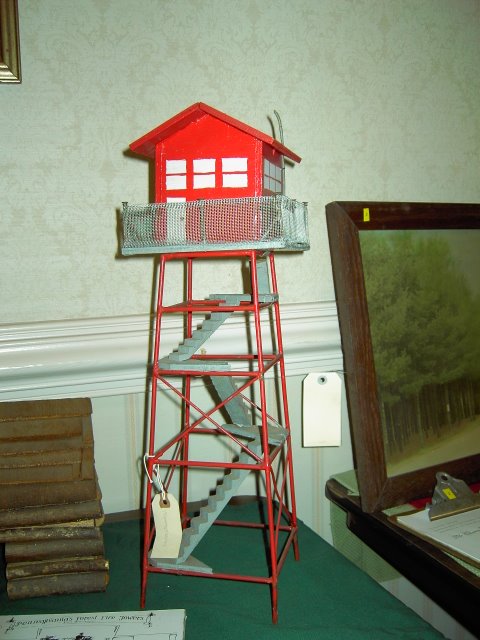
Also, Guilford Township has made available office space in a restored farm building in Norlo Park to the PFFMA
This is part of a display of fire watch towers
 .
. Jim Nelson brought a display of old axes and forestry tools. He described how blacksmiths from the colonization onward modified European methods to make axes adapted to American conditions.
Thursday, November 02, 2006

Pennsylvania's hardwood forests are among its most valuable resources. Black cherry from PA is famous around the world. The hardwood industry accounts for thousands of jobs and millions of dollars to the economy. It is good to know that there are scientists working hard on conserving and improving hardwood species. The Hardwood Tree Improvement & Regeneration Center at Purdue University http://www.htirc.org (with support from the USDA Forest Service)
Scientists at the center are doing basic and applied research on species such as black walnut, red and white oak, green ash, and many others. Most of their research results are directly available from the web site. This is very handy for students doing research projects and foresters looking for practical information. Here is an article entitled: Successful Stock Production for Forest Regeneration: What Foresters Should Ask Nursery Managers About Their Crops (and Vice Versa).
It's well worth a look.
Subscribe to:
Posts (Atom)