Sunday, April 29, 2007

Arboretum Ceremony

The Penn State Mont Alto Arboretum ceremony was held today to recognize memorial tree recipients and donors.

Forest Technology students, and some alumni now at University Park, led tours of the arboretum and guided donors to their tree.


Chancellor David Gnage starts the proceedings


Adam Ryan (right) shows alumnus George Siehl and his wife Nancy his giant sequioa memorial tree.


Darren Krebs and Matt Groves enjoyed the forestry alumni pig roast.
Posted by Picasa

Arbor Day Beauty

In honor of Arbor Day, here is a gallery of blooming trees on the Penn State Mont Alto campus. The blooms only last for a short time, which can be shortend by rain and wind. But it's great while it lasts.


Friday, April 20, 2007

Mont Alto Academic Fair

At yesterday's campus academic there were several forestry entries.
-- Cristie Shull, Deer census transects (1st place)
-- Mike McCormick, GIS map of the Mont Alto Arboretum (2nd place)
-- Cristie Shull and Derick Nye, Botanical drawings (Honorable Mention)
-- Angela Kellert, Forest soil suitability mapping of Franklin County
-- Mark Colwell, Timber harvest mapping on the Waynesboro Watershed
-- Rich Briggs, Prescribed burn planning and mapping on the Waynesboro Watershed
-- Matt Reitzel, Fir tree mapping and species identification on the Mont Alto Arboretum

Thursday, April 19, 2007

Tree Risk Assessment Workshop


Arborists from Bartlett Tree Experts led a tree risk assessment seminar at Mont Alto this past Wednesday, April 18. About twenty park managers from Pennsylvania DCNR and thirty forestry students attended. As part of the workshop trees around campus were evaluated for health and safety.
Posted by Picasa

Tree Removal at Mont Alto

Old trees may be our friends, especially on a college
campus. But when the trees are weakened by disease
and age they become a hazard to all. Here is an example
of a removal of two trees on the Penn State Mont Alto
campus.

Unlike a forest where the logger can fell a tree with a
chainsaw and yell "Timber!", an arborist needs to take
a tree apart branch by branch to prevent damage to
surrounding buildings and the landscape.

Monday, April 16, 2007

Woodsmen Team Victorious


P1000602
Originally uploaded by P_Linehan.

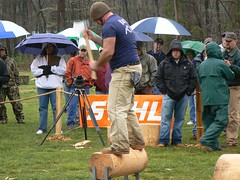
The Penn State Mont Alto Woodsmen Team handily won the Mid-Atlantic meet held Saturday, April 14 at the Dabney S. Lancaster Community College in Clifton Forge, VA. against five other collegiate teams.

All fourteen competitors placed or ribboned in one or more events. Events included axe throw, archery, bolt split, pole climb, pole fell, chainsaw speed cut, and crosscut.

It was a cold and rainy day, but everyone had a great time. all the competitors showed great sportsmanship and no one was hurt. Thanks to the folds at Dabney S. Lancaster for hosting the event!

Bolt Split


P1000574
Originally uploaded by P_Linehan.

Sara Merrill competes in the bolt split event.

Crosscut


P1000638
Originally uploaded by P_Linehan.

Chris Peiffer and Glenn Werner on crosscut.

Stihl Timbesports Collegiate Competition


Tom Oliver competed as Mont Alto's representative to the Stihl Timbersports Collegiate Series competition at the Mid-Atlantic Woodsmen's meet at Dabney S. Lancaster Community College in Clifton Forge, VA. Tom came in second overall in a field of five.

Tom was interviewed for ESPN-U cable channel. They are planning a show on the collegiate competitions in July.

Congratulations, Tom!

Wednesday, April 04, 2007

Russian GPS: GLONASS

Russia Challenges the U.S. Monopoly on Satellite Navigation
Published: April 4, 2007
Russia plans to launch eight navigation satellites to compete with the Global Positioning System operated by the U.S.

This New York Times article describes the Russian effort to complete its own GPS system, called GLONASS, by launching eight more satellites. This would make it operational over the Russian land mass and nearby countries. The network is seen as a competitor to the US system and an effort to bolster Russia's prestige. Many countries fear reliance on an American system in case of problems in international relations. The article says that the European system, Galileo, is stalled over fears of unprofitability. The Chinese are also planning a system.

Conceivably a GPS receiver that could use multiple systems would be more accurate. It could also work even when one system or the other was unavailable. Even at the best of times the US system may work intermittently, although it is much better now than previously.

It would be great if the countries working on GPS could develop a universal system. Since that seems unlikely, they should at least cooperate on standards to benefit all users.

For now the systems we have work well in the forest, but every improvement is welcome.


Tuesday, April 03, 2007

Forest Inventory in Florida


Penn State Mont Alto forest technology alumnus Chris McGarvey (06) sends in this picture of himself working on a forest inventory plot in Florida. Chris writes:
"I was working with our state QA guy (Jay Frost with the USFS) who took the picture. We were chaining out to one of the subplots on an FIA permanent plot in western Washington county in the Florida panhandle. Plot center was about maybe 75 feet from a creek (tributary to the Choctahatchee Rvr) which has overspilled its banks onto the immediate floodplain (not sure why since it has been very dry state-wide here). We got about waist-deep in pretty quick moving water (was a warm day but the water was a bit chilly - photo was taken in mid March). A cottonmouth was sunning him/herself on one of our tally trees.....property was a bit remote (owned by the NW FLA water mgmt district) and required a mile or so hike to get to it. "
Thanks for the picture Chris. Be careful with the snakes!

Friday, March 30, 2007

Timber Harvesting Visit


Students from the Forest Management Practices class visited a 40 acre timber harvesting operation in Rye Township (near Marysville) yesterday. Consulting forester, and Mont Alto alumnus Michael Waldron (in the red vest in the top picture) explained the silvicultural and landowner goals for this oak stand on the side of a hill. He also described how a forester has to meet landowner goals, silvicultural standards, and loggers' needs while still earning income from the job. Good communication and a willingness to listen are critical. Thanks, Mike, for a great visit. Click here for more pictures.
Posted by Picasa

Sunday, March 25, 2007

Mira Lloyd Dock Presentation


To help celebrate Women's History Month, Dr. Susan Rimby from Shippensburg University presented a program on the life and times of Mira Lloyd Dock, one of the founders of the Pennsylvania State Forestry Academy at Mont Alto and the Pennsylvania State Forestry Commission, this past Tuesday March 20th. According to Dr. Rimby, Dock was the "Founding Mother" of the forestry academy. She was beloved by the students as a mentor and counsellor. While respecting the Victorian mores of her time, Dock was active in forestry, conservation, and urban beautification at a time when few women were involved in public life. She was a leader in women's clubs both in Pennsylvania and nationally. She used the clubs to motivate women to become real powers in the conservation movement. Dr. Rimby is currently writing a biography of Dock.

Wednesday, March 21, 2007

Healthy Hemlocks

During spring break from Penn State I visited my family in Maine. Taking a hike in the Thorncrag Bird Sanctuary in Lewiston I came across this lovely stand of healthy hemlock. In most of Pennsylvania the hemlock woolly adelgid has decimated the hemlock forests. I had forgotten how attractive a stand of healthy hemlock trees looks. No wonder it was made the state tree of Pennsylvania. This just shows the danger of invasive species and pests.
Posted by Picasa

Sunday, February 25, 2007

Forestry and Winter Driving


After the Valentine's Day storm in Pennsylvania there has been much criticism of PennDOT, the State Police, and PEMA (PA Emergency Mgt. Agency) over the blockage and closing of all of Interstate 78 and parts of Interstate 80 and 81. Some motorists were left stranded 12 or more hours.

Although the plowing and storm management operations should be evaluated, I think we should also look at how forest vegetation can be used to manage snow build-up on highways. By planting long rows of trees across open areas snow drifts can be prevented. This diagram comes from a Univ. of Minnesota report that explains how big a living snow fence should be to have the maximum benefit. (http://www.extension.umn.edu/distribution/naturalresources/DD7277.html ) If less snow accumulates, then plowing is quicker, easier, and more effective.

If forests are too close to, or overhang, a road the shading effect can favor ice buildup, which leads to the problems we had in PA after the Valentine's Day storm. Rights of way have to be cleared of trees and shrubs to let the sun in.

Even in the age of the automobile, it's better to let Mother Nature take care of our road maintenance as much as possible.

Friday, February 16, 2007

Allegheny SAF Meeting

With this week's big winter storm (at least big by mid-atlantic standards) I didn't make it to the first day of the Society of American Foresters Allegheny meeting in Hagerstown, MD. But there were some very interesting talks on Thursday morning (2-15) that made the trip worthwhile.

David Curson, the director of bird conservation for the MD/DE Audubon Society of talked about the Important Bird Areas Program (IBA). This is an attempt to identify critical habitat for endangered bird species. The program has been successful by working with the federally mandated State Wildlife Action Plans (SWAP). This voluntary program actually favors active forest management, since there are many species of birds requiring the whole range of habitats from clearcuts to older growth forests.

Dan Heddrick, of the Maryland DNR Forest Service, described a research project in western MD to study timber harvesting on small plots (1 to 10 acres). The logger is using a four-wheeler and a chain saw. The study will examine the economic feasibility and social acceptability of the work.

With land fragmentation becoming a critical problem, landowners of small lots (ten acres or less) need help with what to do on their properties. Jonathan Kays of the the Maryland Cooperative Extension Service described a new manual/workbook for these landowners, titled The Woods in Your Backyard. The workbook has been audience tested and should help landowners who are tired of moving their lawns and want to bring a little nature back. http://www.naturalresources.umd.edu/backyard.cfm

Al Todd of the Forest Service gave a summary of the recent report The State of Chesapeake Forests from the Conservation Fund. The report was presented to the governors of the states draining into the Chesapeake who are all members of the Chesapeake Bay Program. Forest fragmentation and development are causing deforestation, soil erosion, and loss of habitat that are having a dire effect on the bay. We risk losing all the environmental services that the forests and the bay provides. According to the report, we are close to the point of no return, where decisive action needs to be taken.

The director of the Maryland Forest Service, Steve Koehn, gave the final word. According to Steve, the problems of development, ownership fragmentation, and deforestation, are affecting all natual resources uses and industries. Foresters need to become politically active to influence the situation. We have to show how these problems affect people's lives, health, and pocketbooks to get the decision makers (politicians) to take action.

Only the Penn State University Park students made it to the meeting. So instead of a quiz bowl, they had an old-timers vs. students quiz bowl. Next year Mont Alto and the other schools will all be there for a real competition.

Monday, February 05, 2007

Flatbush Gardener: Be an NYC Tree Guardian

Flatbush Gardener: Be an NYC Tree Guardian

Here's an interesting entry from the Flatbush Gardener about ways citizens can protect street trees in New York City. Most people don't realize that New York City has a very extensive forested park system. It also has thousands of street trees. These trees grow in a very stressful environment. Without the active support of the people of New York, they wouldn't survive at all.

That's an important lesson for forester. Trees and forests won't prosper, let alone survive, in today's world unless people think they should. Foresters need to work as much with people as with the forests.

Friday, January 26, 2007

Forest Damage in Europe


As we were discussing in forest management this week, forests, both natural and plantations, are very stable, safe investments. The probability of damage from fire, insects, or weather is actually quite low when you consider forests as a whole.

But when damage occurs it can be catastrophic. Here is a quote on the recent storm damage in Sweden:

"About 12 million cubic metres have been estimated to be damaged in the recent storm that swept southern Sweden 14 January. Next to the storm “Gudrun” two years ago this is the most severe storm since 1969. Much of the storm-felled trees are within areas that already have a high risk of large-scale outbreak of the European Spruce bark beetle."
Here is the link to the article: http://www.nordicforestry.org/article.asp?Data_ID_Article=2263&Data_ID_Channel=33

The damage in Germany is equally serious: "

Forestry officials said the hurricane that tore through Germany killing 11 people last week also knocked down 40 million trees. The damage was expected to cost the industry dearly." http://www.dw-world.de/dw/article/0,2144,2323760,00.html

So, forests are usually safe, but when something bad happens it can be very bad.
Thanks to Eggers Thies (Sweden information) and David South (Germany information) for these leads

Monday, January 22, 2007

Queen of Trees


Tonight (1/21) the PBS Nature series broadcast a documentary on the life cycle of the African fig tree (http://www.pbs.org/wnet/nature/queenoftrees/)

The film was made highlighting a tree in Kenya. Here are some pictures I took recently of a fig tree in Guinea, across the continent, at the C.E.E.D. in Kinkan. These pictures seem to be of a very similar, if not exactly the same, species as the one on the show. It's an amazingly complicated life-cycle, with a very precise relationship between the fig tree and the wasp. The fruit here are immature. I noticed ants on them, but didn't see any wasps.

Sunday, January 21, 2007

Forest Contrasts


These are pictures of forests from opposite sides of the world. The single tree is a nere tree (Parkia biglobosa) in the Fouta Djalon highlands of Guinea (near the Kinkan Waterfalls). The forest is a white pine plantation (Pinus strobus) on the Waynesboro Watershed in Hamiltonban Township in Pennsylvania USA. I visited these two landscapes withing ten days of each other in January 07. Jet travel is great!

In spite of the obvious contrasts in continent and climate these two scenes have similarities. Both have trees and both are heavily influenced by human use. The same principles of forest management and soil conservation can be used to manage both landscapes for the benefit of people and the environment.

Saturday, December 09, 2006

Squirrel Nests


PICT0190
Originally uploaded by P_Linehan.

Leaf drop can reveal hidden aspects of the environment. In this yellow poplar on the Mont Alto campus all the squirrel nests now show up. It's like a squirrel condominium complex.

Tuesday, November 28, 2006

Forester Web Sites

In the Forestry Computer Applications course students learn many computer techniques that are needed in forestry such as spreadsheets and document preparation. Communication in the digital requires knowledge of the web. Here are the sites that this fall's students are developing. Remember, they are works in progress.

Sunday, November 26, 2006

Pennsylvania Deer Season


Tomorrow is the start of Pennsylvania's two week statewide deer hunting season. As this article in the Harrisburg Patriot News shows there is still a great deal of mistrust among hunters of the increased doe limits and the concurrent doe and buck season. (See the PA Game Commission site, where I linked to this picture.)

Many of the hunters are saying that deer are becoming scarcer and harder to find. The article points out that with more bucks surviving each year, they are becoming more wily and better able to evade hunters. In any case, it's still true that in much of Pennsylvania it is impossible to regenerate a hardwood forest without a big investment in deer fencing. See my previous post. It doesn't make sense to allow one use of the forest (deer hunting) to monopolize all the other uses and even deter efforts to regenerate forests for future use.

I truly hope this year's hunt goes off in safety with no hunter accidents.

Wednesday, November 22, 2006

The Shifting North Pole


The December 2006 National Geographic has an amazing map of the 700 mile movement of the North Magnetic Pole since its discovery in 1831. If it keeps on moving like it has in the past, it will be in Russia in a few years. The accompanying notes by Joel K. Bourne, Jr. indicates the pole is moving at a rate of 25 miles a year! The article suggests that "... it might be be time to trade that trusty compass for a handheld GPS."

Actually, compasses are very reliable on a day to day basis while GPS receivers are subject to periodic outages and loss of signal under certain conditions. I recommend carrying both into the field. A magnetic compass needs no batteries, while a GPS offers a large number of navigation and tracking tools.

I looked on the National Geographic web site to see if the map in the magazine is online. As of today it isn't. But they do have this news article from last December describing research by Joe Stoner, a paleomagnetist at Oregon State University. He has found that the movement of the pole is completely normal. It gives researchers a window into the liquid iron core at the center of the earth. It also influences the aurora borealis!
Monday, November 20, 2006

Forest Fires and Global Warming

Mont Alto alumnus Eric Straley sent me this news link http://news.yahoo.com/s/ap/20061116/ap_on_sc/cooling_fires about a study of the long term effects of forest fires in northern (spruce fir) forests. It seems that the fire releases large quantities of carbon and pollutants at first. But the next year the same site with longer lasting snow cover and light-colored hardwood regrowth will actually reflect light back to space which would reduce global warming. It takes at least 80 years for the dark-colored softwood forest to be re-established.

The article quotes the researchers as saying that wildfires are just one factor in global warming and this issue needs more study to understand what's going on. However, as global warming is a long term phenomenon made up of the sum of all activities on earth I get a little skeptical about the importance of individual studies of one part of a very complicated system. It's not enough to really decided how to change policies and actions.

Thanks, Eric, for the interesting article and stay warm in Anchorage, AL!

Wednesday, November 15, 2006

Ann Frank Chestnut Tree to be Cut Down


Officials in Amsterdam have concluded that the Anne Frank chestnut tree is too badly infected to be saved and should be cut down. According to news accounts the 150-170 year old tree has been attacked has been attacked by an aggressive fungus and a moth, called the horse chestnut leaf miner.

In her diary, written while her family was hiding from the Nazis in an apartment in a nearby warehouse the teenage Anne wrote movingly how the tree inspired her and gave her hope.

Here is a link to a website with information on the tree and the people it has inspired. Officials at the Anne Frank museum are planning to plant a new chestnut sapling after the old tree has been removed in the next few weeks.

Sunday, November 12, 2006

Google vs. Yahoo! Imagery


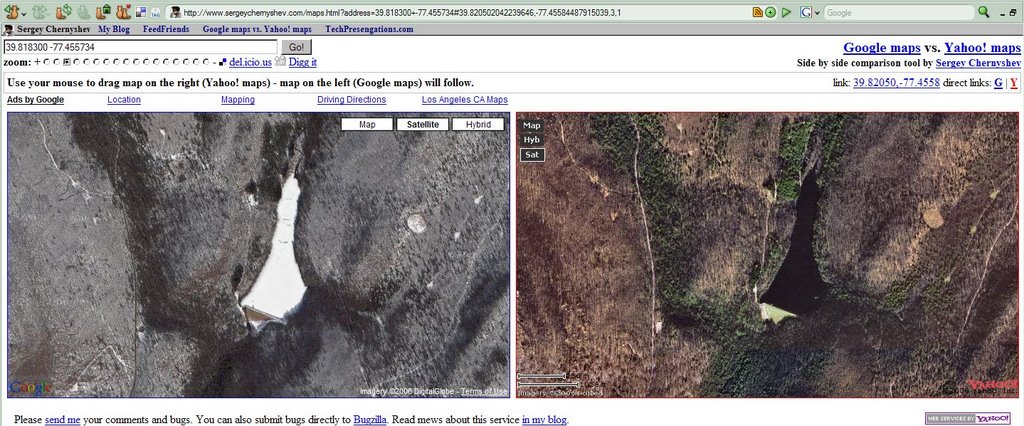
The image above is a screen capture from an amazing map hack by Sergey Chernyshev that puts Google (left) and Yahoo! maps side by side. To get the above comparison of the Waynesboro Reservoir in the Waynesboro Watershed (where we hold many labs in the Penn State Mont Alto forest technology program) first go to this web address: http://www.sergeychernyshev.com/maps.html . Then enter these search coordinates: 39.818300 -77.455734 (latitude and longitude). Make sure to choose satellite imagery to see just the images or hybrid to see the images and roads.

Both images are high resolution, high quality. Online mapping services tend to have spotty coverage of the best imagery around the US. Google shows a winter scene, where the reservoir is frozen. Yahoo! shows a slightly color enhanced summer scene. The road networks use the same data from Navteq. It' great to be able to see them together side by side.

Online mapping is a trend. It's likely that foresters and other natural resource managers will be using these tools in the future to improve their understanding of the forests and to make field work more efficient. Thanks, Sergey, for this new tool.

Wednesday, November 08, 2006

Plant a Billion Trees

http://www.foxnews.com/story/0,2933,228198,00.html

Wangari Maathai, who was just the keynote speaker at the Soc. of American Foresters Convention in Pittsburgh, is calling for a billion trees to be planted to slow global warming. I admire her reliance on citizen groups and women power rather than government programs. They have a greater chance to succeed in the long run. What a change that would make!

Tuesday, November 07, 2006

We are here.


PICT0126
Originally uploaded by P_Linehan.

Student Ryan Thrush is entering a waypoint with a Garmin 60 GPS receiver. We have had good luck with this model. It is versatile and fairly easy to learn.

Learning GPS


PICT0134
Originally uploaded by P_Linehan.

GPS receivers have become ubiquitous tools for forestry field work to locate forest inventory plots, mark trails, and a host of other tasks. Here students in the Forest Mapping Systems class at Penn State Mont Alto are returning from recording waypoints on a trail in the Michaux State Forest.

Monday, November 06, 2006

Deer Fencing


PICT0128
Originally uploaded by P_Linehan.

To regenerate a forest in Pennsylvania deer fencing is a must. Here in the Michaux State Forest next to Penn State Mont Alto campus a deer fence has been set up to allow oak regeneration after a thinning in a pine stand. The gate is to let people in, but keep deer out.

Sunday, November 05, 2006

Follow this link to the PA Forest Fire Museum Association Web site:
http://paforestfiremuseum.org/

More forestry tools

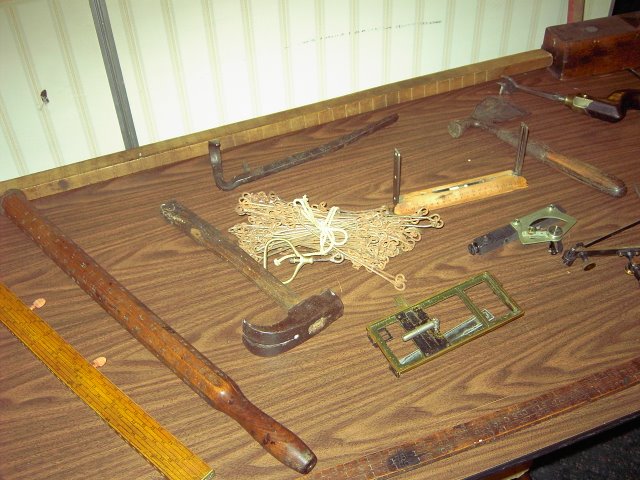
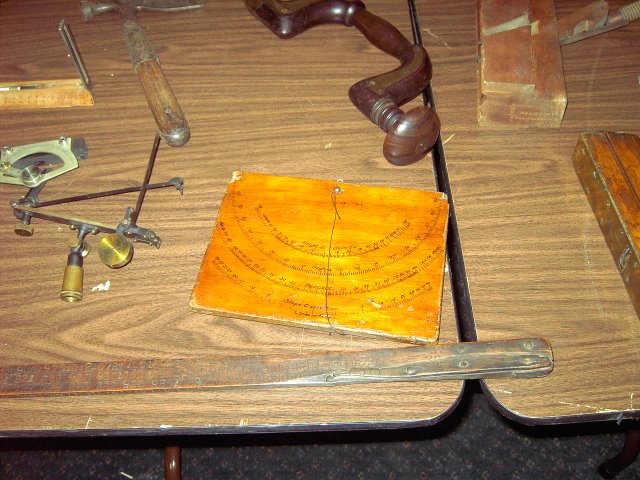
More of Jim Nelson's tools. At the center is a chain (66 feet) made up of 100 links. The rulers are log rules.
In this photo is a student-made clinometer, possibly from Mont Alto. An old washer provides the plumb weight. The instrument has several scales, such as percent, degrees, and tree height at one chain. Posted by Picasa

Pennsylvania Forest Fire Museum Annual Meeting


Yesterday was the annual meeting of the PFFMA in Chambersburg. Here is the group shot. There were some interesting developments for the museum project. A temporary museum will soon be opening in the old office building at Caledonia State Park.
Also, Guilford Township has made available office space in a restored farm building in Norlo Park to the PFFMA


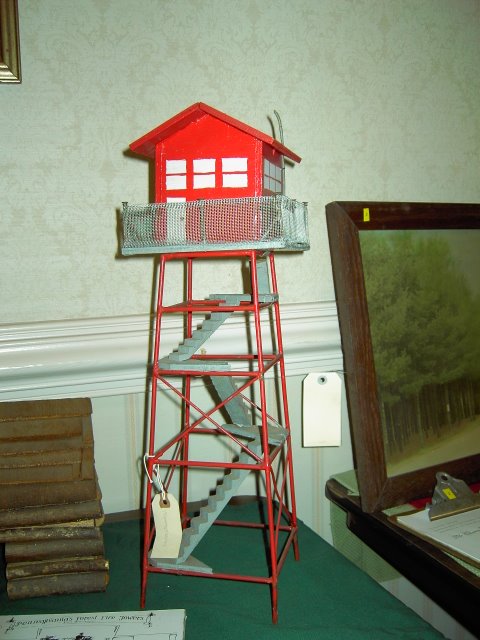
This is part of a display of fire watch towers.

Jim Nelson brought a display of old axes and forestry tools. He described how blacksmiths from the colonization onward modified European methods to make axes adapted to American conditions. Posted by Picasa

Thursday, November 02, 2006


Pennsylvania's hardwood forests are among its most valuable resources. Black cherry from PA is famous around the world. The hardwood industry accounts for thousands of jobs and millions of dollars to the economy. It is good to know that there are scientists working hard on conserving and improving hardwood species. The Hardwood Tree Improvement & Regeneration Center at Purdue University http://www.htirc.org (with support from the USDA Forest Service)

Scientists at the center are doing basic and applied research on species such as black walnut, red and white oak, green ash, and many others. Most of their research results are directly available from the web site. This is very handy for students doing research projects and foresters looking for practical information. Here is an article entitled: Successful Stock Production for Forest Regeneration: What Foresters Should Ask Nursery Managers About Their Crops (and Vice Versa).
It's well worth a look.